
I meet a lot of people who earn good money and still have almost nothing saved for a home. They are not reckless. They work hard, they pay their bills, and they treat themselves now and then. The problem is that “now and then” adds up to thousands of dollars a year, and most of these spending habits happen without a second thought.
This is not a lecture. None of the habits below are “bad.” Coffee is not bad. Dinner out is not bad. A vacation is not bad. The question is simple: is this habit worth more to you than the keys to your own home? Sometimes the answer is yes, and that is fine. But you should get to decide on purpose.
Below are 50 everyday spending habits I see over and over. Next to each one is an example cost so you can see how small amounts turn into big ones. Your numbers will be different. That is the point. You can plug in your own with my free Down Payment Savings Calculator.
Why small spending habits matter so much
A $6 coffee does not feel like a down payment. But $6, five days a week, is about $1,560 a year. Add lunch out, a few delivery orders, and some subscriptions you forgot about, and you can be looking at $10,000 or more a year that never makes it to savings.
On a $400,000 home, a first-time buyer using a Conventional loan with 3% down needs $12,000 for the down payment. Closing costs are separate and often run around 2% to 4% of the price, although seller credits can cover some or all of them. Eligible veterans and service members may be able to buy with 0% down using a VA loan. See more low down payment options for first-time buyers.
So for many buyers, the gap between “someday” and “this year” is a handful of habits.
The 50 everyday spending habits
The example costs below are illustrations only, not averages. Use your own real numbers.
Daily habits
These are the quiet ones. Small, frequent, and easy to forget.
| # | Habit | Example | Per year |
|---|---|---|---|
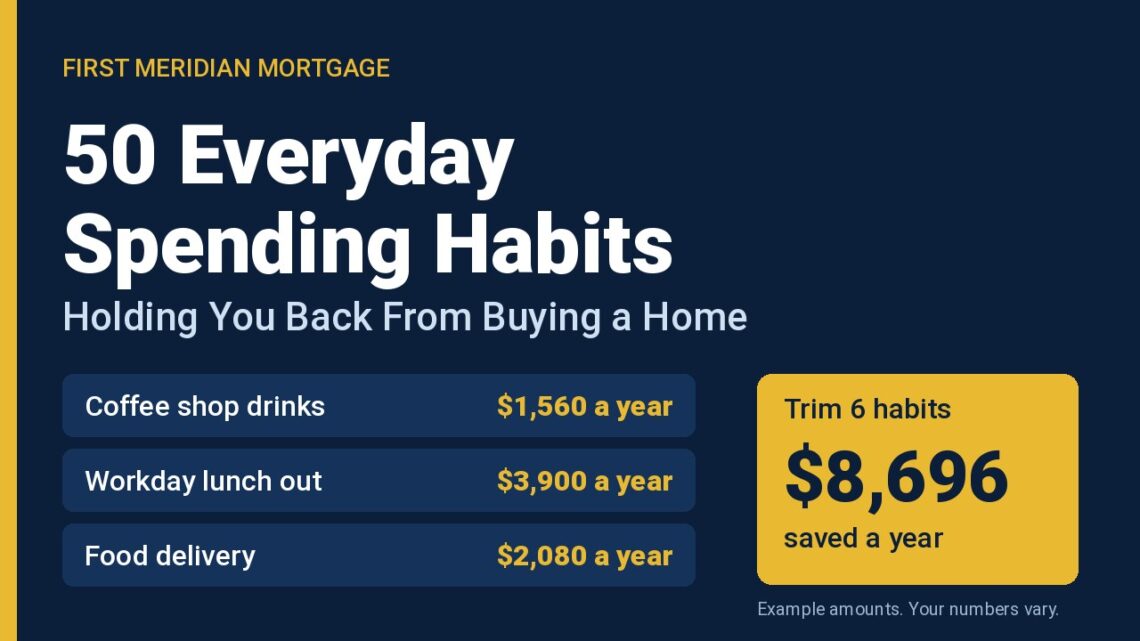
| 1 | Coffee shop drinks | $6, 5 days a week | $1,560 |
| 2 | Energy drinks and sodas | $3.50, 5 days a week | $910 |
| 3 | Bottled water and grab-and-go drinks | $2.50, 5 days a week | $650 |
| 4 | Breakfast on the go | $8, 3 days a week | $1,248 |
| 5 | Workday lunch out | $15, 5 days a week | $3,900 |
| 6 | Snacks and vending machines | $3, 5 days a week | $780 |
| 7 | Cigarettes or vaping | $10 a day | $3,650 |
| 8 | Lottery tickets and scratch-offs | $5, 5 days a week | $1,300 |
| 9 | Gas station impulse buys | $6, 3 times a week | $936 |
| 10 | Afternoon treat | $6, 3 times a week | $936 |
| 11 | In-app and mobile game purchases | $20 a week | $1,040 |
| 12 | Daily parking and tolls | $12, 5 days a week | $3,120 |
Weekly habits
These usually feel like “just this weekend.” Then the weekend comes every week.
| # | Habit | Example | Per year |
|---|---|---|---|
| 13 | Food delivery apps | $40 a week | $2,080 |
| 14 | Dinner out at restaurants | $80 a week | $4,160 |
| 15 | Takeout and pickup | $35 a week | $1,820 |
| 16 | Happy hour and bar tabs | $45 a week | $2,340 |
| 17 | Alcohol for home | $30 a week | $1,560 |
| 18 | Rideshare trips | $30 a week | $1,560 |
| 19 | Impulse online orders | $40 a week | $2,080 |
| 20 | “Just a few things” store runs | $50 a week | $2,600 |
| 21 | Weekend brunch | $50 a week | $2,600 |
| 22 | Car washes and detailing | $20 a week | $1,040 |
| 23 | Sports betting and fantasy | $25 a week | $1,300 |
| 24 | Movies and entertainment outings | $40 a week | $2,080 |
| 25 | Wasted groceries and impulse items | $25 a week | $1,300 |
| 26 | Nights out and clubs | $60 a week | $3,120 |
Monthly habits
These are the autopilot charges. Many of them renew whether you use them or not.
| # | Habit | Example | Per year |
|---|---|---|---|
| 27 | Video streaming services | $65 a month | $780 |
| 28 | Music and audio subscriptions | $12 a month | $144 |
| 29 | Cable or premium sports packages | $120 a month | $1,440 |
| 30 | Gym or studio membership you rarely use | $60 a month | $720 |
| 31 | Gaming subscriptions and in-game spending | $25 a month | $300 |
| 32 | Apps, cloud storage and software | $30 a month | $360 |
| 33 | Subscription boxes and meal kits | $120 a month | $1,440 |
| 34 | Hair, nails and grooming | $120 a month | $1,440 |
| 35 | Clothing and shoes | $150 a month | $1,800 |
| 36 | Beauty and skincare products | $60 a month | $720 |
| 37 | Car payment above what you need | $250 a month extra | $3,000 |
| 38 | Premium phone plan and device financing | $60 a month extra | $720 |
| 39 | Credit card interest | $150 a month | $1,800 |
| 40 | Bank, ATM and overdraft fees | $25 a month | $300 |
| 41 | Late fees and penalty charges | $30 a month | $360 |
| 42 | Buy now, pay later installments | $100 a month | $1,200 |
Yearly habits
These are the big ones that feel like “one time” purchases. They usually come back every year.
| # | Habit | Example | Per year |
|---|---|---|---|
| 43 | Vacations and big trips | $4,000 a year | $4,000 |
| 44 | Weekend getaways | $1,500 a year | $1,500 |
| 45 | Concerts, games and event tickets | $1,200 a year | $1,200 |
| 46 | Holiday and gift overspending | $1,000 a year | $1,000 |
| 47 | New phone or tech upgrades | $1,200 a year | $1,200 |
| 48 | Sneakers, collectibles and hobby gear | $800 a year | $800 |
| 49 | Home decor and furniture upgrades | $1,000 a year | $1,000 |
| 50 | Golf rounds, leagues and hobby fees | $1,500 a year | $1,500 |
Nobody does all 50. But most people I talk to recognize 10 or 15 of themselves on this list right away.
See what your habits cost with the free calculator
The habits that hurt twice
A few of these do more than drain savings. They can also affect your mortgage itself.
- Credit card interest, late fees and overdrafts (39, 40, 41). Late payments can hurt your credit score, and your score affects your rate and your loan options. Paying down balances can save you interest now and may help your pricing later.
- A car payment above what you need (37). Monthly debt payments count against you when a lender figures how much house you can afford. A bigger car payment can mean a smaller home budget.
- Buy now, pay later and device financing (38, 42). These feel small, but they can add up to monthly obligations that make a budget tighter than it looks.
When you trim these, you are not only saving cash. You may be improving your whole mortgage picture.
Trim, do not quit
You do not have to give up everything you enjoy. Here is a simple example of trimming six habits, not cutting them out.
| Habit | Before | After | Saved per year |
|---|---|---|---|
| Workday lunch out | 5 days a week | 2 days a week | $2,340 |
| Dinner out | $80 a week | $40 a week | $2,080 |
| Food delivery | $40 a week | $10 a week | $1,560 |
| Impulse online orders | $40 a week | $15 a week | $1,300 |
| Coffee shop drinks | 5 days a week | 2 days a week | $936 |
| Streaming services | $65 a month | $25 a month | $480 |
| Total | $8,696 |
That is about $725 a month. At that pace, the $12,000 down payment on a $400,000 home with 3% down is reachable in about 17 months. And this household still gets coffee, still eats out, and still watches TV.
Simple steps to start saving for a down payment
- Look at the last 90 days. Pull up your bank and credit card statements. Circle every habit from this list.
- Pick your top five. Choose the ones that cost the most and matter the least to you.
- Set a “trim” number, not a “quit” number. Cut in half instead of cutting to zero. You are more likely to stick with it.
- Move the savings automatically. Set up an automatic transfer to a separate savings account the day you get paid. If you do not see it, you will not spend it.
- Know your real target. Your down payment depends on the loan program. Talk to a loan officer early, or start with getting pre-approved, so you are saving for the right number, not a guess.
For the bigger picture, read the 12 steps to homeownership.
Run your own numbers
I built a free tool for exactly this. The First Meridian Down Payment Savings Calculator asks quick questions about your daily, weekly, monthly and yearly habits, then shows you how much you could save and how fast you could reach your goal. It takes a few minutes, and it does not judge.
When you have your numbers, call me at 703-799-5626 or send me a message. I will help you figure out which loan program fits, what your real cash-to-close target is, and whether seller credits or other options could get you there sooner.
You do not need to earn more to buy a home. You may just need to keep more of what you already earn.
Start the Down Payment Savings Calculator
Common questions
Which spending habits make it hardest to save for a house?
The ones that repeat. Food delivery, dining out, coffee and workday lunches, subscriptions you forgot about, credit card interest and car payments above what you need can add up to thousands of dollars a year.
How much do I need to save for a down payment?
It depends on the loan program and price. On a $400,000 home, a first-time buyer using a Conventional loan with 3% down needs $12,000. FHA starts at 3.5% down, and eligible veterans and service members may buy with 0% down using a VA loan. Closing costs are separate, often around 2% to 4% of the price, and seller credits can cover some or all of them.
Do I have to give up everything I enjoy to buy a home?
No. Trimming works better than quitting. In the example in this article, cutting six habits back instead of cutting them out saves $8,696 a year, about $725 a month.
Can my spending habits affect my mortgage approval?
Yes. Late payments can lower your credit score, which affects your rate and loan options. Monthly debts like car payments, buy now, pay later plans and device financing count against you when a lender figures how much home you can afford.
How can I see what my own habits cost?
Use the free First Meridian Down Payment Savings Calculator. It asks about your daily, weekly, monthly and yearly habits and shows how much you could save and how fast you could reach your goal.
This article is for educational purposes only and is not a loan approval or commitment to lend. Loan programs, down payment and closing costs vary by property, credit and lender guidelines. Example spending amounts are illustrations, not averages.
First Meridian Mortgage Corporation, NMLS #180004, is licensed in Virginia only by the Virginia State Corporation Commission, license #MB-1029. Kevin Retcher, NMLS #116922, serves Virginia borrowers through First Meridian Mortgage Corporation. NMLS Consumer Access. Equal Housing Opportunity.